
Denis Doulgeropoulos
Your Financial Professional & Insurance Agent
Child Tax Credit for 2021: Will You Get More?
If you have qualifying children under the age of 18, you may be able to claim a child tax credit. (You may also be able to claim a partial credit for certain other dependents who are not qualifying children.) The American Rescue Plan Act of 2021 makes substantial, temporary improvements to the child tax credit for 2021, which may increase the amount you might receive.

Ages of Qualifying Children
The legislation makes 17-year-olds eligible as qualifying children in 2021. Thus, children ages 17 and younger are eligible as qualifying children in 2021.
Increase in Credit Amount
For 2021, the child tax credit amount increases from $2,000 to $3,000 per qualifying child ($3,600 per qualifying child under age 6). The partial credit for other dependents who are not qualifying children remains at $500 per dependent.
Refundable Credit
The aggregate amount of nonrefundable credits allowed is limited to tax liability. With refundable credits, a taxpayer may receive a refund at tax time if they exceed tax liability. For most taxpayers, the child tax credit is fully refundable for 2021. To qualify for a full refund, the taxpayer (or either spouse for joint returns) must generally reside in the United States for more than one-half of the taxable year. Otherwise, under the pre-existing rules, a partial refund of up to $1,400 per qualifying child may be available. The credit for other dependents is not refundable.
Advance Payments
Taxpayers may receive periodic advance payments for up to one-half of the refundable child tax credit during 2021, generally based on 2020 tax returns. The U.S. Treasury will make the payments for periods between July 1 and December 31, 2021. For example, monthly payments could be up to $250 per qualifying child ($300 per qualifying child under age 6).
Phaseout of Credit
The combined child tax credit (the sum of your child tax credits and credits for other dependents) is subject to phaseout based on modified adjusted gross income (MAGI). Special rules start phasing out the increased portion of the child tax credit in 2021 at much lower thresholds than under pre-existing rules. The credit, as reduced under the special rules for 2021, is then subject to phaseout under the pre-existing phaseout rules.
Phaseout of Credit in 2021
80% of care at home is provided by unpaid caregivers
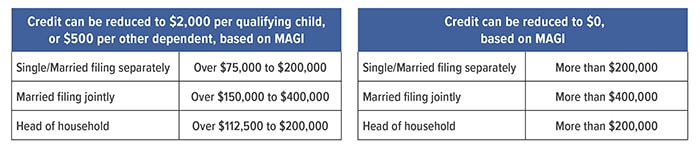
For 2021, the credit does not decrease as long as a taxpayer’s modified adjusted gross income (MAGI) does not exceed $75,000. Similarly, joint filers and surviving spouses qualify with MAGI up to $150,000, while heads of household remain eligible up to $112,500. However, once MAGI exceeds these income limits, the credit begins to phase out.
At this stage, the IRS reduces the credit by the lowest of the following three amounts:
First, $50 for every $1,000, or fraction thereof, by which MAGI exceeds the applicable threshold.
Second, the total increase in the credit amount for 2021. For example, if a taxpayer has three qualifying children—two of whom are under age six—the increased credit of $10,200 minus the pre-existing $6,000 credit results in a $4,200 increase.
Third, $6,250 for single filers, $12,500 for joint returns, $4,375 for heads of household, or $2,500 for surviving spouses. Notably, these limits equal 5% of the difference between the higher pre-existing phaseout thresholds and the special 2021 thresholds.
Under this special rule for 2021, the credit remains at least $2,000 per qualifying child or $500 per other dependent and cannot fall below those amounts. Nevertheless, taxpayers with MAGI above $200,000—or $400,000 for joint filers—may lose the credit entirely under the existing phaseout rules. In this final phase, the IRS further reduces the credit by $50 for every $1,000, or portion thereof, that MAGI exceeds the applicable threshold.
This information does not provide tax, legal, investment, or retirement advice or recommendations, and you should not rely on it to avoid federal tax penalties. We encourage you to consult an independent tax or legal professional for guidance. We compiled this content from sources we believe to be accurate. The information and opinions expressed do not solicit the purchase or sale of any security. Broadridge Advisor Solutions wrote and prepared this material. © 2021 Broadridge Financial Solutions, Inc.