
Denis Doulgeropoulos
Your Financial Professional & Insurance Agent
Considerations When Making Gifts to Children
If you make significant gifts to your children or someone else’s children (perhaps a grandchild, a nephew, or a niece), or if someone else makes gifts to your children, there are a number of things to consider.

Nontaxable Gift Transfers
There are a variety of ways to transfer assets to children without triggering gift tax. Generally, you must file a gift tax return only if you make gifts, other than qualified transfers, totaling more than $15,000 per individual in a single year.
Furthermore, careful planning can help you stay within these limits.
Providing Support
If state law requires you to support your child, the IRS does not treat that support as a taxable gift. This rule helps parents of minor children, college-age children, adult children living at home, and children who require additional care or assistance avoid unintended tax consequences.
Annual Exclusion Gifts
You can generally make tax-free gifts of up to $15,000 per child each year. Moreover, if you and your spouse combine gifts, the annual amount effectively increases to $30,000 per child.
Qualified Transfers for Medical Expenses
You may make unlimited tax-free gifts for medical care, provided you pay the medical provider directly. As a result, these payments do not count toward the annual gift tax exclusion.
Qualified Transfers for Educational Expenses
You can also make unlimited tax-free gifts for tuition, as long as you pay the educational institution directly. Therefore, these transfers avoid gift tax entirely.
For generation-skipping transfer (GST) tax purposes, the same exceptions for nontaxable gift transfers generally apply. However, the GST tax operates separately and typically applies when you transfer property to someone two or more generations younger than you, such as a grandchild.
Income Tax Issues
A gift is not taxable income to the recipient. However, when you give property to a child, several income tax issues may arise from income generated by the property or from its sale. Therefore, understanding these rules is essential.
Income Used for Support
Income generated from property owned by your child is taxed to you if that income fulfills your legal obligation to provide support. Consequently, ownership alone does not always shift the tax burden.
Kiddie Tax
Under the kiddie tax rules, children may be taxed at their parents’ tax rates on unearned income exceeding $2,200 (in 2021). Specifically, these rules apply to children under age 18, to 18-year-olds whose earned income does not exceed one-half of their support, and to full-time students ages 19 to 23 whose earned income does not exceed one-half of their support.
Basis of Gifted Property
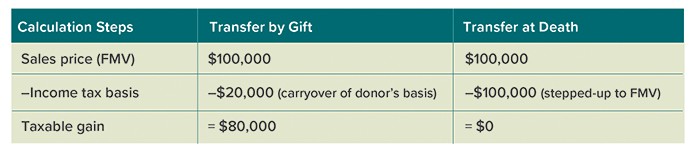
When you make a gift, the recipient generally takes your income tax basis in the property. As a result, this basis determines the taxable gain if the child later sells the asset. In contrast, if the property transfers at death, the child receives a stepped-up or stepped-down basis equal to the property’s fair market value.
Transfer by Gift Versus Transfer at Death
There is often a significant difference in taxable gain when a child sells appreciated property received by gift compared with property inherited at death. Consequently, evaluating both options can help minimize future tax liability.
Gifts to Minors
Outright gifts should generally be avoided for any significant gifts to minors. For this purpose, you might consider a custodial gift or a trust for a minor.
Custodial gifts. Gifts can be made to a custodial account for the minor under your state’s version of the Uniform Gifts/Transfers to Minors Acts. The custodian (an adult or a trust company) holds the property for the benefit of the minor until an age (often 21) specified by state statute.
Trust for minor. A Section 2503(c) trust is specifically designed to obtain the annual gift tax exclusion for gifts to a minor. Principal and income can (but need not) be distributed to the minor before age 21. The minor does generally gain access to undistributed income and principal at age 21. (The use of trusts involves a complex web of tax rules and regulations, and usually involves upfront costs and ongoing administrative fees. You should consider the counsel of an experienced estate professional before implementing a trust strategy.)
This information is not intended as tax, legal, investment, or retirement advice or recommendations, and it may not be relied on for the purpose of avoiding any federal tax penalties. You are encouraged to seek guidance from an independent tax or legal professional. The content is derived from sources believed to be accurate. Neither the information presented nor any opinion expressed constitutes a solicitation for the purchase or sale of any security. This material was written and prepared by Broadridge Advisor Solutions. © 2021 Broadridge Financial Solutions, Inc.